
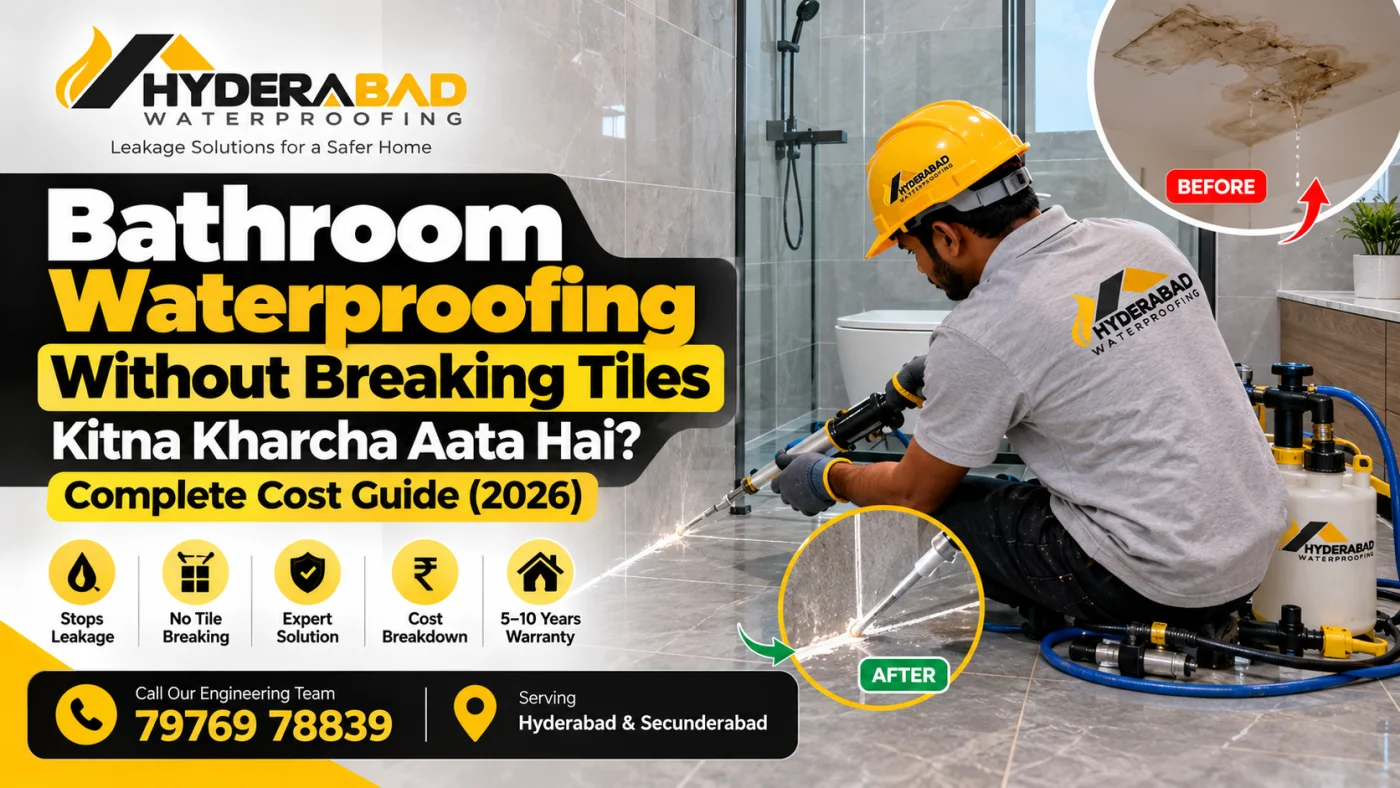
Bathroom leakage is a common problem in apartments, independent houses and villas across Hyderabad. You may notice damp patches on the ceiling below your bathroom, peeling paint near bathroom walls, water seeping into an adjoining room or persistent moisture around floor joints.
The biggest concern for many homeowners is the cost of repairing the leakage. Nobody wants to remove perfectly good bathroom tiles unless it is necessary.
The good news is that some bathroom leakage problems can be treated without breaking the existing tiles. However, the correct treatment depends on the source of leakage, the condition of the grout, the plumbing system and the waterproofing membrane beneath the floor.
What Is the Cost of Bathroom Waterproofing Without Breaking Tiles in Hyderabad?
For preliminary budgeting in 2026, homeowners may encounter the following indicative estimates:
Epoxy grout and joint sealing: ₹2,000–₹5,000 per bathroom.
Localised surface waterproofing or compatible tile-top treatment: ₹3,000–₹8,000 per bathroom.
Specialised leakage repair or PU injection treatment: ₹3,000–₹8,000 or more, depending on the defect.
Complete re-waterproofing requiring tile removal: ₹15,000–₹40,000 or more, depending on the bathroom size, plumbing work and replacement finishes.
These are broad planning estimates, not confirmed quotations. Actual prices depend on the leakage source, treatment system and amount of repair work required. Published Hyderabad pricing guides also show that costs vary significantly by scope and whether tile removal is involved. Source: Gracia Waterproofing | Source: Asian Paints
The important point is that avoiding tile removal is possible in selected cases, but it cannot replace a failed waterproofing membrane in every situation.
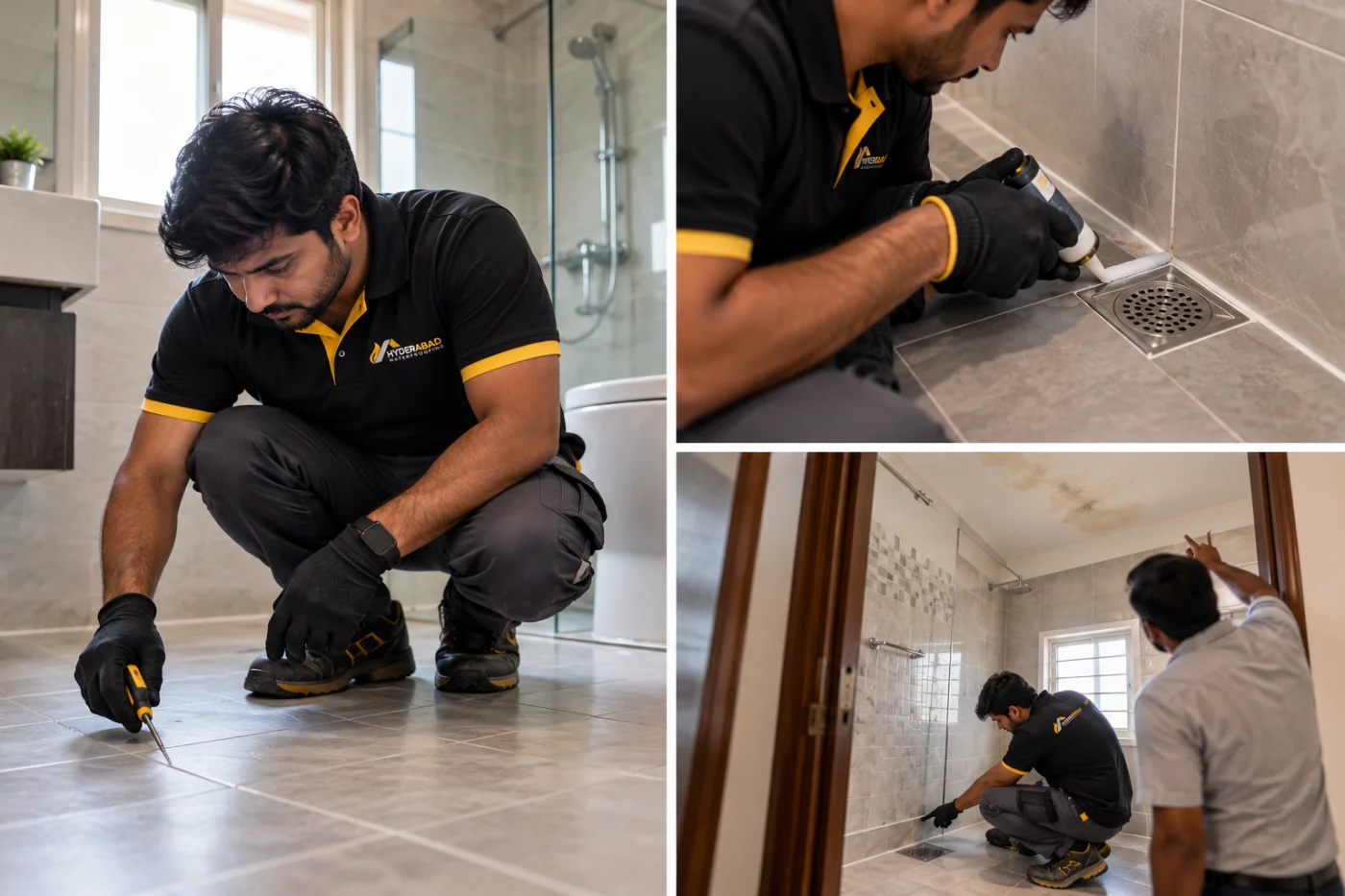
1. Why Does Bathroom Leakage Occur?
Before selecting a waterproofing treatment, it is important to identify how water is entering the building structure.
1.1 Damaged Tile Grout
Tile grout fills the joints between adjacent tiles. Over time, grout can crack, deteriorate or separate from the tile edges.
Water can penetrate these joints and reach the underlying layers, particularly when the original waterproofing system is damaged or inadequate.
Possible solution: Remove deteriorated grout where necessary and apply a compatible grout replacement or joint-sealing system.
This treatment may help when the leakage is related to defective joints, but it will not correct a leaking pipe or a failed underlying membrane.
1.2 Failed Waterproofing Membrane
The waterproofing membrane is generally installed beneath the tile and bedding layers. It protects the concrete slab and surrounding building components from water penetration.
If this membrane has failed, water may pass through the floor assembly even when the tiles look perfectly normal.
Possible solution: A specialist may assess whether a compatible surface treatment can provide temporary or limited improvement. If the underlying membrane has failed extensively, removing the affected tiles and reinstating the waterproofing system may be necessary.
1.3 Leaking Concealed Plumbing Pipes
Water supply pipes, waste pipes and drainage connections can develop leaks inside walls or beneath floors.
A plumbing leak may continue even after the grout has been repaired or a surface coating has been applied.
Possible solution: Identify the affected pipe or connection and repair it before deciding whether additional waterproofing is needed.
1.4 Leakage Around Floor Traps and Pipe Penetrations
The floor trap, drain outlet and pipe-to-floor junctions are common areas where water can enter the building structure.
If these connections were not properly sealed during construction, leakage may develop around the drain even when the rest of the bathroom floor appears sound.
Possible solution: Inspect the drain connection and surrounding joints. Depending on accessibility and damage, localised repairs or tile removal may be necessary.
1.5 Missing or Damaged Floor-Wall Junction Sealing
The junction between the bathroom floor and wall is exposed to repeated wetting. Defective sealant, cracked grout or inadequate waterproofing at this junction can contribute to seepage.
Possible solution: Repair the affected joint using a compatible system after checking whether the problem is limited to the surface or extends beneath the tiles.
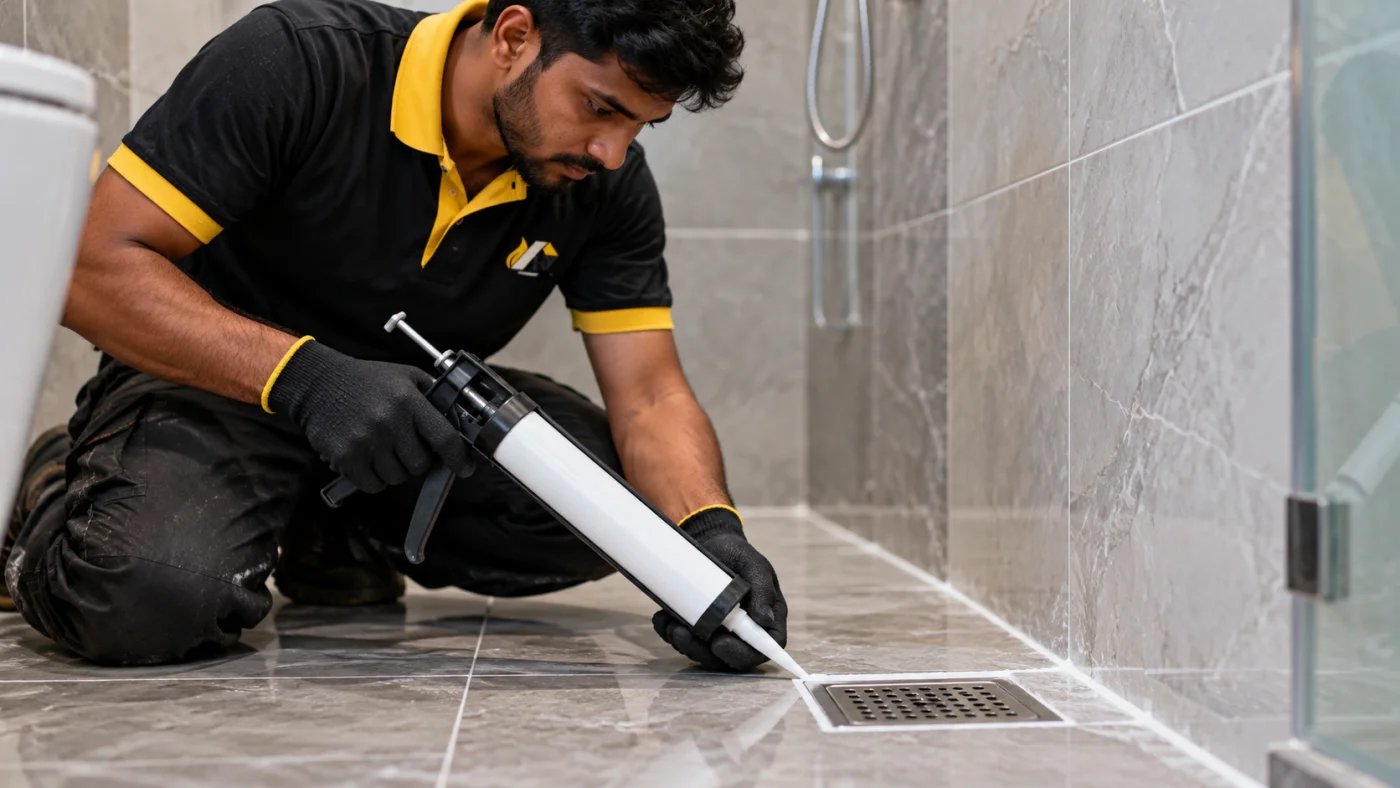
2. Bathroom Waterproofing Methods Without Breaking Tiles
Several treatment options may be considered when homeowners want to preserve their existing bathroom tiles.
The suitability of each method depends on the actual cause of leakage.
| Treatment Method | Indicative Cost | Suitable Situation | Main Limitation |
|---|---|---|---|
| Grout replacement and joint sealing | ₹2,000–₹5,000 per bathroom | Deteriorated grout and minor joint defects | Does not repair failed concealed waterproofing |
| Compatible tile-top waterproof coating | ₹3,000–₹8,000 per bathroom | Selected surfaces suitable for an approved coating system | Adhesion and durability depend on product compatibility |
| Localised sealant repair | ₹1,500–₹4,000 per affected area | Accessible joints and selected pipe penetrations | Not suitable for widespread membrane failure |
| Specialised injection or targeted leakage treatment | ₹5,000–₹15,000+ per project | Selected concrete cracks or accessible leakage paths | Requires correct diagnosis and suitable substrate |
| Complete membrane replacement | ₹15,000–₹40,000+ per bathroom | Extensive failure beneath the tiles | Usually involves demolition and reinstatement |
Pricing note: These ranges are indicative estimates for budgeting. Minimum project charges, bathroom size, material specification, access and additional plumbing or civil repairs can change the final cost.
Method 1: Grout Replacement
If the leakage is associated with deteriorated grout, the affected joints may be cleaned and refilled using a compatible grout product.
The process generally involves:
Inspecting the grout lines and tile condition.
Removing deteriorated grout where required.
Cleaning and preparing the joints.
Applying compatible replacement grout.
Sealing suitable movement joints with an appropriate sealant.
Allowing the repair to cure according to the product instructions.
This method can help address defective grout joints, but it should not be presented as a complete waterproofing solution when the underlying membrane has failed.
Method 2: Tile-Top Waterproof Coating
Some specialist products are designed for application over compatible existing tile surfaces.
The application may involve cleaning, removing surface contaminants, preparing the substrate and applying the specified primer or coating.
Before selecting this option, confirm:
Whether the product is approved for the particular tile surface.
Whether it can tolerate the expected water exposure.
Whether the coating is suitable for the bathroom floor or only certain wall surfaces.
Whether it provides adequate slip resistance.
Whether the product is compatible with the existing sealants and drainage details.
A coating applied over tiles does not automatically restore the original waterproofing membrane beneath them.
Method 3: Localised Joint and Drain Repair
If leakage is concentrated around a floor trap, pipe penetration or accessible joint, a targeted repair may be possible.
The contractor should check the condition of the drain assembly and nearby tiles before applying sealant.
If the drain body is cracked or its connection beneath the floor has failed, surface sealing alone may not provide a reliable repair.
Method 4: Specialised Injection Treatment
Injection grouting may be considered for selected cracks and water ingress paths in concrete structures.
The injection material and method must be selected according to the crack condition, water pressure, substrate and accessibility.
Injection grouting is not a universal solution for bathroom leakage. It cannot automatically repair deteriorated grout, defective plumbing or a widespread failure of the waterproofing membrane.
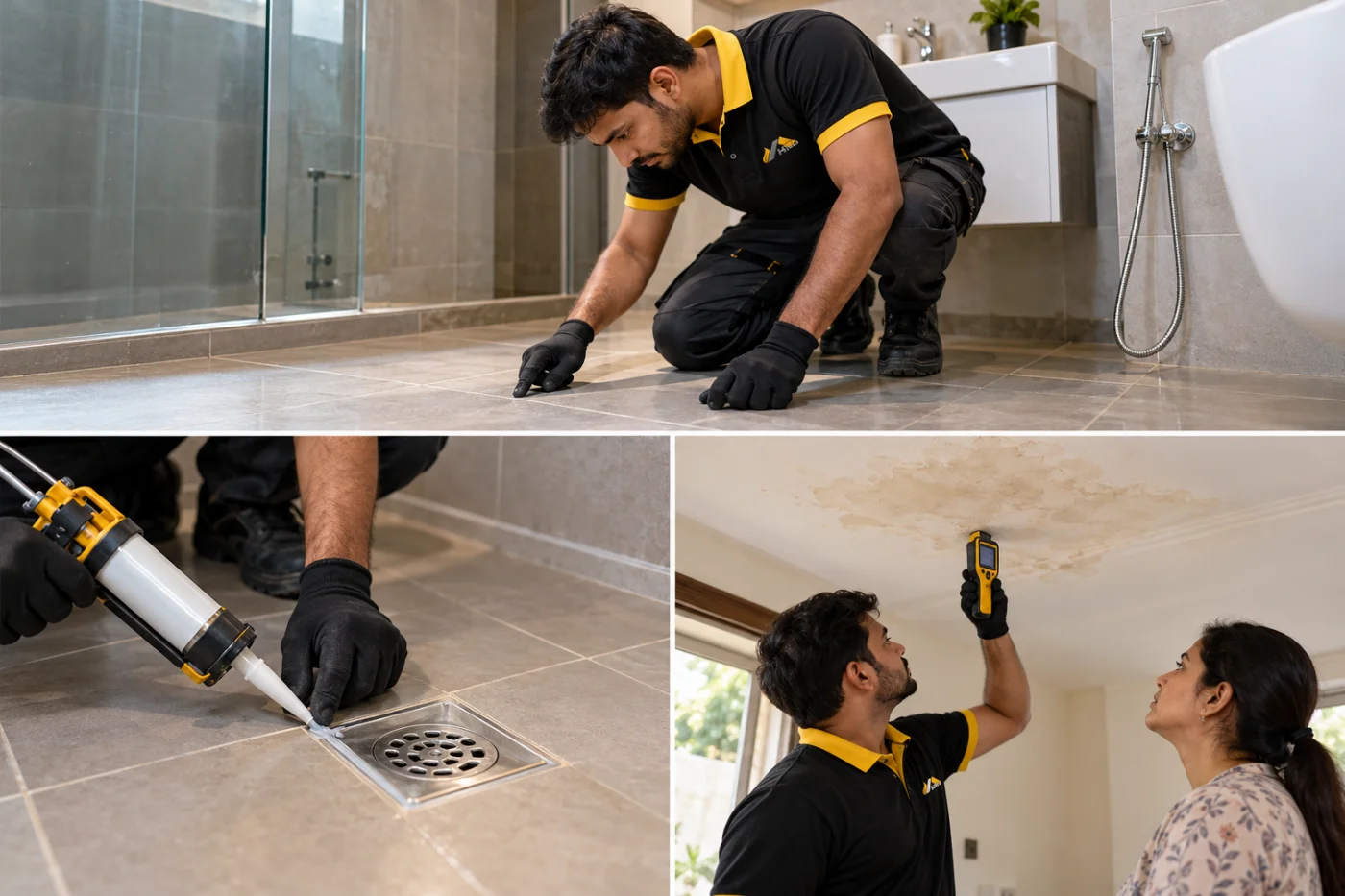
3. Bathroom Waterproofing Cost Per Sq Ft in Hyderabad
Some contractors quote bathroom waterproofing per square foot, while others charge a fixed amount per bathroom.
The difference depends on the scope of work and the type of treatment.
| Waterproofing Scope | Indicative Rate |
|---|---|
| Basic compatible surface treatment | ₹40–₹80 per sq ft |
| Standard waterproofing system before tiling | ₹60–₹110 per sq ft |
| Premium membrane system before tiling | ₹100–₹200+ per sq ft |
| Repair of an existing tiled bathroom | Often priced per bathroom or repair scope |
These figures are indicative market estimates and should not be interpreted as fixed rates for every Hyderabad project. Published pricing guides report different ranges depending on whether the work involves a new installation, surface repair or complete membrane replacement. Source: Asian Paints | Source: Studio Matrx
Example: Cost for a 40 Sq Ft Bathroom
Consider a bathroom with a floor area of 40 sq ft.
If a selected treatment is priced at ₹70 per sq ft:
Estimated cost = 40 × ₹70 = ₹2,800
However, this calculation may cover only the specified treated surface. It may exclude minimum labour charges, wall treatment, plumbing repairs, drain replacement, tile removal or additional finishing.
For this reason, a per-bathroom quotation with a clearly defined scope may be more useful than comparing per-square-foot rates alone.
4. How to Identify the Source of Bathroom Leakage
Correct diagnosis helps avoid unnecessary repairs.
A damp ceiling below the bathroom does not automatically mean that the entire bathroom floor requires waterproofing.
Signs of Grout or Joint Problems
Visible cracks or gaps between tiles.
Deteriorated grout around the shower area.
Water entering around accessible joints.
Leakage that appears after the floor or shower is used.
These signs justify a closer inspection of the joints, but they do not prove that the grout is the only source.
Signs of a Possible Plumbing Leak
Persistent dampness even when the bathroom has not been used.
Unexplained water consumption.
Leakage associated with a particular water supply line.
Dampness around concealed pipe routes or plumbing connections.
A plumber may need to conduct appropriate pressure or leak tests to identify the source.
Signs of Underlying Waterproofing Failure
Leakage from several floor locations.
Recurring damp patches despite grout repairs.
Water appearing on the ceiling below after prolonged bathroom use.
Multiple failed joints or widespread moisture damage.
These signs may indicate that a larger section of the waterproofing system needs investigation.
Important: Moisture meters and thermal imaging can support an assessment, but they do not independently confirm the exact leakage source in every situation. Findings should be interpreted alongside plumbing tests and physical inspection.
5. Can Bathroom Waterproofing Really Be Done Without Removing Tiles?
Yes, in selected situations. However, the answer depends on the condition of the existing bathroom.
| Bathroom Condition | Can Tiles Usually Be Preserved? |
|---|---|
| Minor grout deterioration | Often possible |
| Defective accessible sealant joints | Often possible |
| Compatible surface treatment required | Possible if the product and substrate are suitable |
| Leaking concealed water pipe | Depends on pipe access and repair requirements |
| Cracked drain assembly beneath the floor | Tile removal may be required |
| Widespread failure of the membrane beneath tiles | Removal is often necessary for complete reinstatement |
| Loose tiles or damaged underlying screed | Removal of affected sections may be necessary |
A responsible contractor should explain the limitations of a no-demolition treatment before work begins.
If the membrane beneath the tiles has failed extensively, applying a coating over the existing floor may only conceal the symptoms temporarily.
6. Dr. Fixit vs Fosroc vs Sika for Bathroom Waterproofing
Dr. Fixit, Fosroc and Sika offer different construction chemical products for waterproofing and repair applications.
The correct product depends on whether the work involves grout joints, concrete, a concealed membrane, pipe penetrations or a surface coating over existing tiles.
| Brand | Example Product Families | Important Considerations |
|---|---|---|
| Dr. Fixit | Pidifin 2K and other compatible waterproofing products | Verify suitability for the specific substrate and exposure |
| Fosroc | Brushbond and other specified waterproofing systems | Check the intended application and installation requirements |
| Sika | SikaTop Seal, Sikadur and other relevant product families | Confirm compatibility with the repair and waterproofing system |
Not every product from these brands is suitable for application over existing bathroom tiles.
Before selecting a material, check the current technical datasheet for surface compatibility, primer requirements, curing time, water exposure limitations and finishing requirements.
The most important factor is not simply the brand. It is whether the selected product is appropriate for the identified leakage source and installed according to its technical specifications.
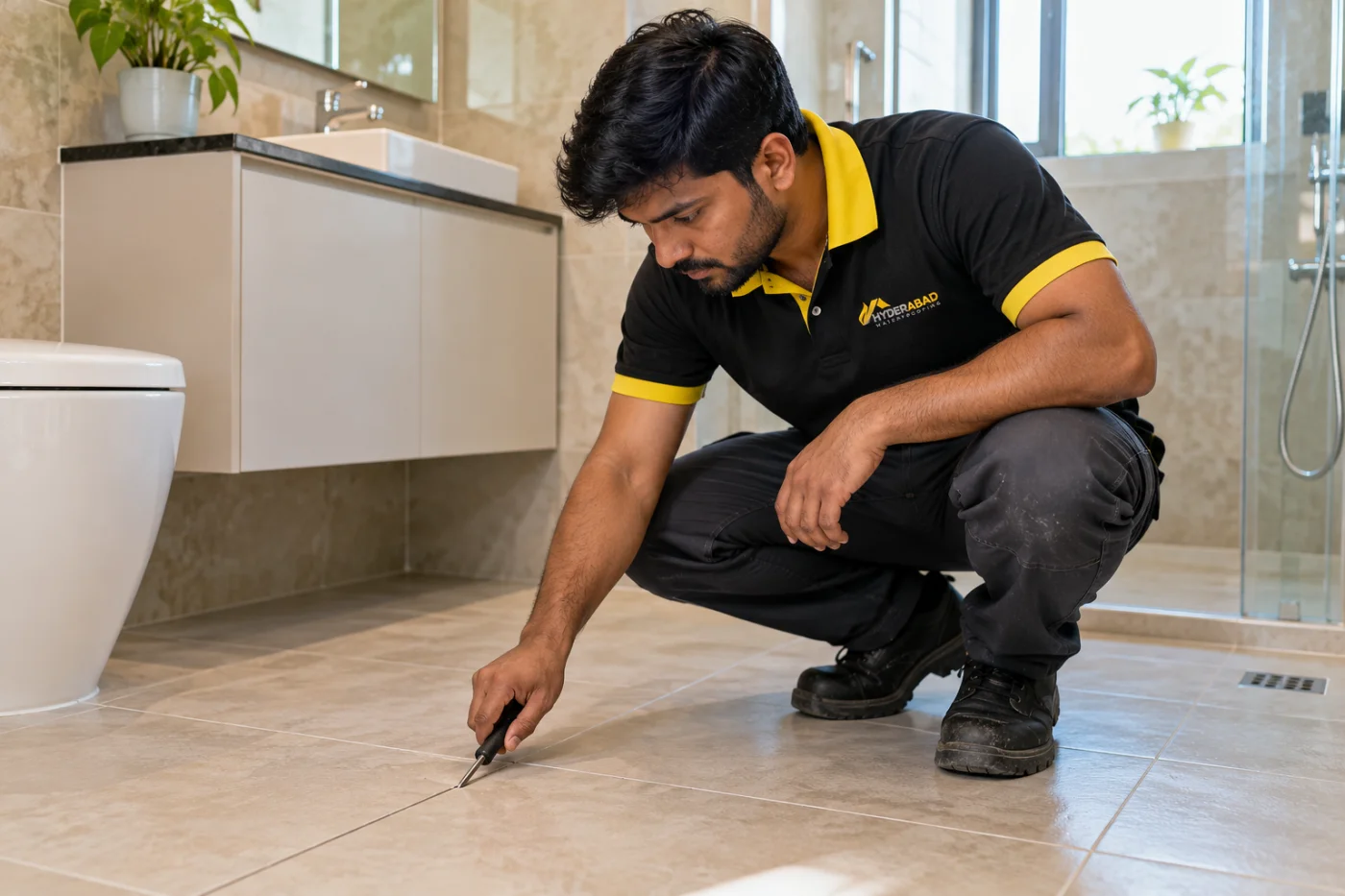
7. Why Bathroom Waterproofing Fails in Hyderabad Homes
Bathrooms across Hyderabad face repeated exposure to water, cleaning chemicals and moisture. Certain conditions can contribute to leakage over time.
Hard Water and Grout Deterioration
Hard borewell water is common in some Hyderabad localities, including Gachibowli, Madhapur, Manikonda and Miyapur.
Mineral deposits and cleaning practices may affect surface appearance and maintenance requirements. However, hard water alone should not be assumed to be the cause of leakage.
Cracked grout, failed sealant, plumbing defects and damaged waterproofing layers should also be investigated.
Poor Installation Around Drain Outlets
A poorly sealed floor trap or pipe connection can allow water to enter beneath the tiles.
The connection between the drain assembly and waterproofing system requires particular attention during construction and repair.
Inadequate Waterproofing Before Tiling
The original waterproofing membrane should be installed before tiles are laid, following the selected system's specifications.
If the membrane was omitted, incorrectly applied or damaged during later work, leakage may develop even when the finished tiles appear intact.
Improper Floor Slope
Bathroom floors should direct water towards the drain. Poor slope can leave water standing near corners, doorways and wall junctions.
Water accumulation can increase exposure to defective joints and contribute to recurring problems.
8. What Does Professional Bathroom Leakage Repair Include?
A professional assessment should focus on the actual leakage source rather than automatically recommending the same treatment for every bathroom.
A typical process may include:
Step 1: Initial assessment
Examine the affected ceiling, adjoining walls, floor joints, shower area, floor trap and visible plumbing connections.
Step 2: Leakage diagnosis
Determine whether the symptoms are more consistent with a plumbing defect, failed grout, a defective joint or underlying waterproofing failure. Additional testing may be required.
Step 3: Treatment recommendation
Identify whether localised repair, grout replacement, a compatible surface treatment, injection grouting or tile removal is appropriate.
Step 4: Surface preparation
Clean and prepare the affected area according to the selected product's requirements.
Step 5: Repair and application
Carry out the agreed work using compatible materials and the specified installation method.
Step 6: Verification
Check the repaired area under appropriate conditions and allow the material to cure fully. Where the work involves a new exposed waterproofing membrane, a controlled water test may be appropriate before the next construction layer is installed.
Step 7: Handover
Provide details of the work completed, maintenance recommendations and applicable written warranty terms.
9. How to Reduce Bathroom Waterproofing Costs
Homeowners can make better repair decisions by following a few practical steps.
Identify the leakage source first. Do not assume that every damp ceiling requires complete bathroom re-waterproofing.
Check plumbing before applying coatings. A leaking pipe needs a plumbing repair.
Preserve sound tiles when appropriate. Ask whether a localised treatment is technically suitable.
Request an itemised quotation. Separate repair work, material, labour, tile removal and finishing.
Compare the proposed treatment, not just the price. Two contractors may be quoting for different scopes.
Ask about warranty exclusions. Understand what is covered and what conditions may invalidate the warranty.
Avoid repeated temporary repairs. If leakage returns after multiple joint-sealing attempts, the underlying cause needs further investigation.
A low initial quotation may not represent the lowest total cost if the treatment does not address the actual source of leakage.
10. Frequently Asked Questions
Q1. What is the bathroom waterproofing without breaking tiles cost in Hyderabad?
For preliminary budgeting, minor grout or joint repairs may cost approximately ₹2,000–₹5,000 per bathroom. Compatible surface treatments may cost around ₹3,000–₹8,000, while specialised repairs can cost ₹5,000–₹15,000 or more. Actual costs depend on the bathroom condition and treatment scope.
Q2. Can bathroom leakage be stopped without breaking tiles?
Yes, when the problem is limited to suitable grout joints, accessible sealant joints or a surface defect that can be treated with a compatible product. If the concealed plumbing or underlying waterproofing membrane has failed, a more extensive repair may be necessary.
Q3. Will applying waterproofing chemicals over tiles permanently stop leakage?
Not in every case. A compatible surface treatment may help with selected defects, but it cannot automatically restore a failed membrane beneath the tiles. The treatment must match the actual leakage source.
Q4. How much does it cost to repair a leaking bathroom ceiling?
The cost depends on whether the cause is a leaking bathroom above, defective plumbing, failed grout or another source of moisture. Repairing the ceiling alone without addressing the source may lead to recurring dampness. The bathroom and affected ceiling should be assessed together.
Q5. How long does bathroom waterproofing take?
Minor joint repairs may be completed relatively quickly, while specialised treatments require additional preparation and curing time. Complete membrane replacement may take several days or longer depending on demolition, plumbing, reinstatement and product curing requirements.
Q6. Do bathroom tiles need to be removed if the waterproofing membrane has failed?
If the underlying membrane has failed extensively, removing the affected tiles is often necessary to reinstate the waterproofing system properly. In some cases, localised repairs may be possible, but the decision depends on the extent and location of the damage.
11. Book a Bathroom Leakage Assessment in Hyderabad
Bathroom leakage should not be ignored, particularly when damp patches appear on the ceiling below, paint starts peeling or water repeatedly enters adjoining walls.
The right repair begins with identifying the cause. In suitable cases, a targeted treatment can help preserve existing tiles. Where the concealed membrane or plumbing has failed, a more extensive repair may be required.
Hyderabad Waterproofing Services provides bathroom leakage assessment and waterproofing solutions for homeowners across Hyderabad and Secunderabad.
Our team can assess the visible symptoms, discuss suitable treatment options and explain whether a repair without tile removal may be appropriate for your bathroom.
Schedule a Site Visit
Hyderabad Waterproofing Services
Phone: 79769 78839
Website: https://hyderabadwaterproofing.in
Service Areas: Hyderabad and Secunderabad
Services: Bathroom leakage repair, waterproofing assessment, wall seepage repair and related waterproofing solutions
Call our engineering team to discuss your bathroom leakage problem and schedule a technical site assessment.
Do not spend money on repeated surface repairs without understanding the source of the leakage. A suitable diagnosis can help you choose the right treatment and avoid unnecessary work.
Editorial Note: All prices are indicative budgeting estimates for 2026 and are not binding quotations. Final pricing depends on site conditions, material selection, repair requirements and the agreed scope of work.