
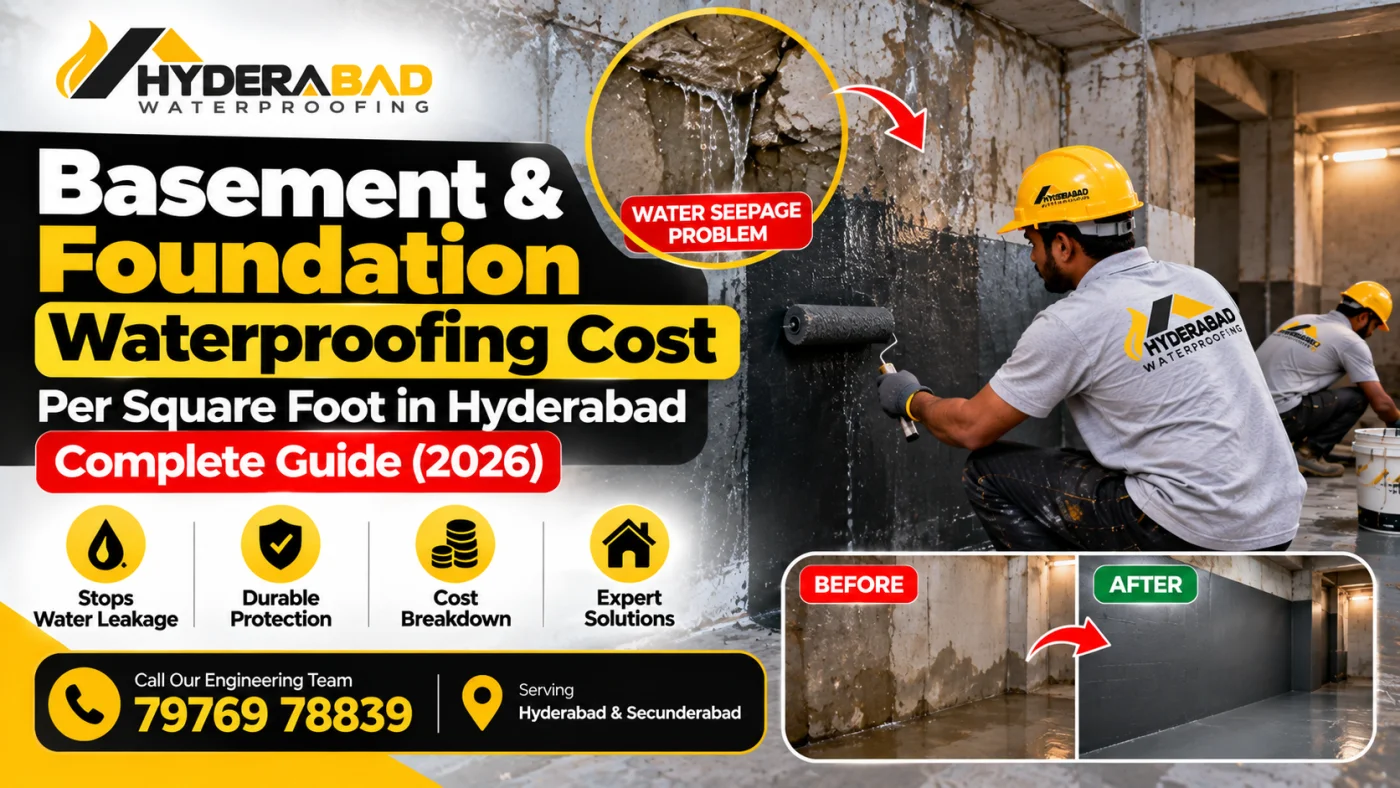
Basement and foundation leakage can become a serious concern for homeowners, apartment associations, builders, and commercial property owners in Hyderabad. Water seepage through underground walls, floor joints, RCC cracks, and foundation surfaces can lead to damp patches, peeling paint, unpleasant odours, and deterioration of concrete over time.
One of the most common questions property owners ask is: What is the basement waterproofing cost in Hyderabad per square foot?
The cost depends on several factors, including the severity of leakage, groundwater pressure, concrete condition, accessibility, and the waterproofing system selected. A minor crack repair may require targeted injection grouting, while a basement with widespread seepage may need a complete waterproofing and drainage solution.
In this guide, Hyderabad Waterproofing Services explains the estimated basement and foundation waterproofing rates in Hyderabad for 2026, the differences between treatment methods, and the factors to consider before selecting a contractor.
What Is the Basement Waterproofing Cost in Hyderabad?
Basement waterproofing in Hyderabad can cost approximately ₹75–₹300 per sq ft, depending on the treatment system, surface condition, and extent of water penetration. Complex foundation waterproofing projects involving excavation, membrane protection, drainage systems, or extensive structural repairs may cost more.
The following table provides indicative budgeting ranges for common basement waterproofing treatments. These are planning estimates, not a confirmed quotation for a specific property.
| Waterproofing Treatment | Estimated Cost |
|---|---|
| Basic cementitious waterproofing | ₹75–₹130 per sq ft |
| Crystalline waterproofing treatment | ₹100–₹180 per sq ft |
| Liquid-applied PU or polymer membrane | ₹120–₹250 per sq ft |
| External foundation membrane system | ₹150–₹300+ per sq ft |
| Localised crack injection grouting | Usually priced per crack or injection point |
| Extensive basement restoration | Depends on repair and drainage requirements |
Market references for Hyderabad show a wide variation in basement waterproofing prices because contractors may include different materials, preparation work, labour, and repair activities in their rates. https://www.asianpaints.com/blogs/waterproofing-cost-in-india.html and https://www.nobroker.in/painting-services/waterproofing-cost-in-hyderabad
Always confirm whether the quoted price includes surface preparation, crack treatment, material application, protective layers, and applicable taxes.
Basement Waterproofing Cost Calculation: Example
Understanding the approximate project budget can help you compare quotations more accurately.
Suppose a basement requires waterproofing over 1,000 sq ft of wall and floor surface.
| Estimated Rate | Approximate Treatment Cost |
|---|---|
| ₹100 per sq ft | ₹1,00,000 |
| ₹150 per sq ft | ₹1,50,000 |
| ₹200 per sq ft | ₹2,00,000 |
| ₹250 per sq ft | ₹2,50,000 |
These calculations cover only the assumed treated area at the selected rate. They do not automatically include excavation, drainage installation, major concrete repairs, structural work, or other excluded items.
The actual measurable area may also be different from the basement's built-up floor area because waterproofing may involve walls, construction joints, retaining walls, and floor-wall junctions.
What Factors Affect Basement Waterproofing Charges in Hyderabad?
1. Severity of Water Leakage
The condition of the basement is one of the most important factors affecting the overall cost.
Minor dampness may require surface preparation and a compatible waterproofing treatment. Active water flowing through cracks or construction joints may need injection grouting before a protective coating can be applied.
If water enters from several locations, the contractor may need to identify the water path and assess whether additional drainage measures are required.
2. Groundwater Pressure
Underground structures are exposed to soil moisture and, in some locations or seasons, groundwater pressure. When water pressure builds up against a basement wall or slab, a surface coating alone may not be sufficient.
The selected system must be appropriate for the actual exposure conditions. Where water pressure is significant, the assessment should consider concrete condition, joints, drainage, and the feasibility of external waterproofing.
3. Type of Waterproofing System
Different systems have different material and installation costs.
Cementitious coatings may suit certain prepared concrete surfaces, while flexible membranes may be more appropriate where movement and exposure conditions require them. Crystalline treatments and injection grouting address different problems and should not be treated as interchangeable solutions.
4. Existing Building vs New Construction
Waterproofing during new construction is generally easier to integrate because the external foundation surfaces may be accessible before backfilling.
For an existing building, the external foundation may be buried under soil, paving, or landscaping. Excavation, access restrictions, temporary water management, and reinstatement can increase the project cost.
5. Crack Repair and Concrete Damage
Cracked concrete, deteriorated construction joints, exposed reinforcement, and damaged plaster may require separate repairs before waterproofing.
Waterproofing should not be used as a substitute for structural assessment where cracks are wide, moving, or associated with settlement or concrete deterioration.
6. Accessibility and Drainage Requirements
Cellars and basements in apartments, villas, and commercial buildings can have restricted access. Moving equipment, controlling water during repairs, installing drainage channels, or arranging excavation can affect labour and project duration.
The final quotation should clearly identify any additional work required.
Types of Basement and Foundation Waterproofing Methods
1. Cementitious Waterproofing
Cementitious waterproofing uses cement-based materials, often modified with polymers, to form a protective layer on prepared concrete surfaces.
It may be suitable for selected internal basement walls, concrete surfaces, and areas with conditions compatible with the specified system.
Advantages:
Suitable for many concrete substrates
Can be practical for prepared internal surfaces
Relatively straightforward application
Available in different formulations for different exposure conditions
Limitations:
Not every cementitious product is suitable for active leakage or sustained negative water pressure
Moving cracks and defective joints may need separate treatment
Surface preparation and curing are important
The suitability of a cementitious system should be confirmed after assessing the source and pressure of the water.
2. Crystalline Waterproofing
Crystalline waterproofing uses specialised materials designed to react within concrete and reduce water penetration through its pore structure.
It may be considered for certain concrete basement walls, slabs, and foundation structures, depending on the product specifications and substrate condition.
Advantages:
Designed for compatible concrete surfaces
Can be useful for selected damp concrete conditions
May complement other repair measures
Limitations:
Does not automatically resolve every active leak or moving crack
Results depend on product suitability, preparation, and application
Construction joints and significant cracks may require additional treatment
3. PU Injection Grouting
Polyurethane injection grouting is commonly used to address water entering through identifiable cracks, joints, and other leakage paths in concrete.
The material is injected through installed packers into the targeted leakage route. The appropriate formulation depends on whether the repair involves active water flow, crack movement, or other site conditions.
Advantages:
Targets specific leakage paths
Can be useful when water is actively entering through cracks or joints
May reduce the need for extensive surface removal in suitable cases
Limitations:
Usually priced according to the number, length, depth, and condition of the cracks or injection points
Does not replace a complete waterproofing system where widespread water penetration exists
The source of leakage must be identified as accurately as possible
For this reason, PU injection grouting may be quoted separately from the per-square-foot waterproofing rate.
4. PU or Polymer Membrane Waterproofing
Liquid-applied membrane systems form a continuous waterproofing layer when installed according to the selected product specifications.
They may be considered for suitable basement and foundation surfaces, particularly where the design requires a flexible membrane.
Advantages:
Can create a continuous protective layer
Available in different formulations and thicknesses
Can be specified for certain complex surface geometries
Limitations:
Substrate moisture and preparation requirements vary by product
The membrane must be compatible with expected water pressure and exposure
Protection against punctures and construction damage may be necessary
5. External Foundation Waterproofing
External or positive-side waterproofing is installed on the side of the foundation that faces the surrounding soil and incoming water.
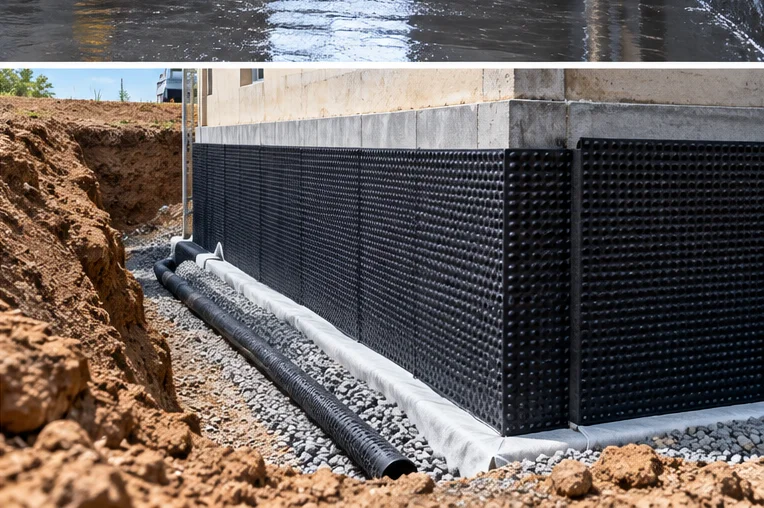
For suitable new-construction projects, this may involve surface preparation, a specified waterproofing membrane, protection boards, and appropriate drainage provisions before backfilling.
For existing buildings, access to the external foundation may require excavation. This can significantly increase the total cost and must be planned carefully.
Internal vs External Basement Waterproofing
| Feature | Internal Waterproofing | External Waterproofing |
|---|---|---|
| Application location | Inside the basement | Outside the foundation wall |
| Access | Often easier in existing buildings | May require excavation |
| Typical applications | Selected damp walls, cracks, and remedial treatments | Foundation protection during construction or accessible remedial work |
| Main considerations | Water pressure, substrate condition, joints | Excavation, membrane protection, drainage |
| Cost factors | Treatment area, leakage severity, repair method | Excavation, access, membrane system, reinstatement |
Internal waterproofing is not always equivalent to preventing water from reaching the concrete. Some internal systems manage water penetration from the negative side, while external systems can prevent water from entering the structure when correctly designed and installed.
The appropriate option depends on the building, the source of leakage, and the feasibility of accessing the external foundation.
Common Signs of Basement and Foundation Leakage
Property owners should arrange a technical assessment if they notice:
Damp patches on underground walls
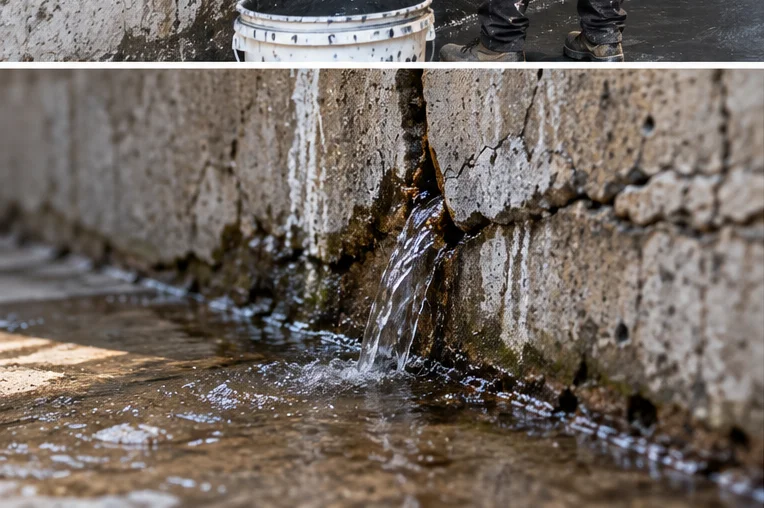
Water entering through cracks or construction joints
Persistent moisture or musty odours in the cellar
White salt deposits on masonry or concrete
Peeling paint or deteriorating plaster near the floor
Water collecting at wall-floor junctions
Repeated leakage after earlier surface repairs
Rust staining or visible concrete deterioration
These symptoms can have different causes, including groundwater seepage, plumbing leaks, surface runoff, condensation, or drainage problems. Correct diagnosis is essential before choosing a treatment.
Basement Waterproofing Challenges in Hyderabad
Basement leakage conditions vary across Hyderabad and Secunderabad. Local soil conditions, seasonal rainfall, groundwater behaviour, construction quality, and the design of the drainage system can all influence the waterproofing strategy.
Heavy Monsoon Rainfall
Rainwater that collects around a building can increase moisture exposure near foundation walls. Poor grading, blocked drains, or inadequate surface-water management may worsen basement dampness.
Underground Water Movement
Groundwater conditions can differ significantly between properties and locations. A basement should be assessed based on observed leakage, drainage conditions, and site-specific exposure rather than assumptions about the entire city.
Concrete Cracks and Construction Joints
Cracks, poorly sealed joints, and gaps around service penetrations can become entry points for water. These locations may need targeted repair before or alongside the main waterproofing system.
Older Buildings and Failed Waterproofing
Existing basements may have deteriorated coatings, damaged concrete, or inaccessible external membranes. The repair strategy should consider the condition of the original system and whether it can be repaired or requires replacement.
Hyderabad Waterproofing Services provides basement and foundation waterproofing assessments for residential, apartment, and commercial properties across Hyderabad and Secunderabad.
Our Basement Waterproofing Process
A systematic approach helps identify the source of leakage and select an appropriate treatment.
Step 1: Site Assessment
The engineering team examines visible dampness, active leaks, cracks, construction joints, floor-wall junctions, and accessible drainage areas.
Step 2: Identify the Likely Water Source
The assessment considers possible groundwater seepage, surface-water entry, plumbing leakage, condensation, and other moisture sources.
Step 3: Select the Appropriate Treatment
Depending on the findings, the proposed solution may involve injection grouting, crystalline treatment, cementitious waterproofing, membrane application, drainage improvements, or a combination of methods.
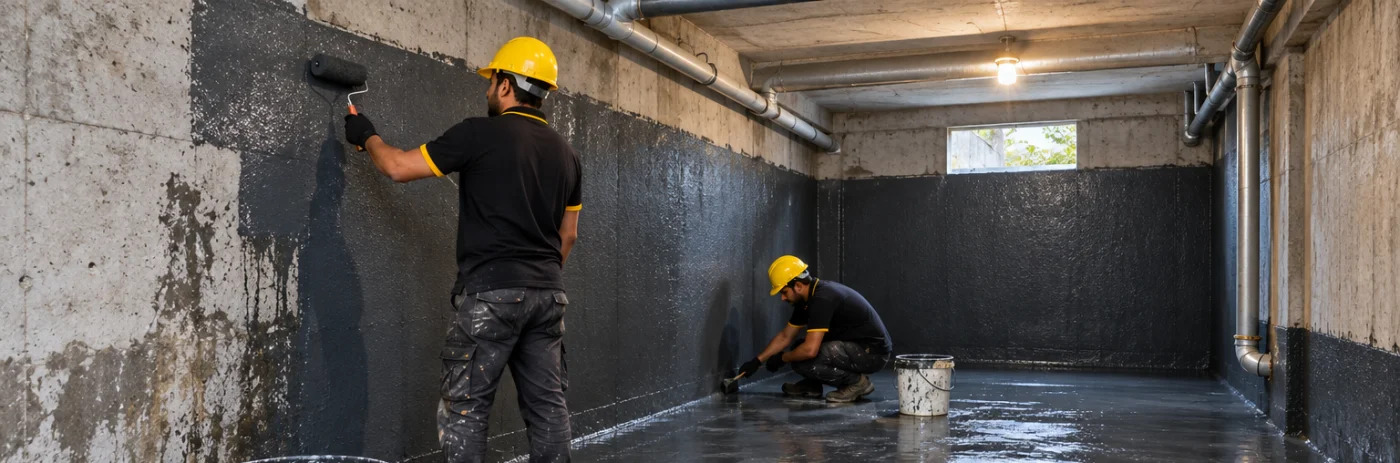
Step 4: Surface Preparation and Repairs
Loose material is removed where required, and compatible repairs are completed. Active leakage points and defective joints are treated according to the selected system.
Step 5: Apply the Waterproofing System
The specified materials are installed according to their technical requirements, including coverage, thickness, curing, and protection provisions.
Step 6: Quality Checks
The completed work is checked against the agreed scope and product requirements. Any appropriate water testing must be planned according to site conditions and the system used.
Step 7: Handover and Maintenance Guidance
The property owner should receive details of the treatment performed, maintenance recommendations, and any applicable written warranty terms.
How to Choose a Basement Waterproofing Contractor in Hyderabad
Before finalising a contractor, ask for:
A clear explanation of the likely water-entry source
The name and type of the proposed waterproofing system
A written scope of work and measurable treated area
Separate pricing for injection grouting, excavation, and major repairs where applicable
Material application and curing requirements
Details of drainage or water-management work, if needed
Written warranty terms that specify coverage and exclusions
A plan for quality checks and handover
Avoid comparing contractors solely on the lowest per-square-foot price. A low rate may exclude essential crack repairs, preparation, membrane protection, or drainage improvements.
Frequently Asked Questions
1. What is the basement waterproofing cost in Hyderabad per sq ft?
Basement waterproofing may cost approximately ₹75–₹300 per sq ft, depending on the method, condition of the concrete, leakage severity, and project scope. Complex excavation, foundation membrane, and drainage projects may cost more.
2. What is the foundation waterproofing cost in Hyderabad?
Foundation waterproofing costs vary according to the treated area, membrane type, excavation requirements, soil conditions, and protection measures. External foundation systems can cost more when access requires excavation and reinstatement.
3. Can basement leakage be repaired without excavation?
Yes, some basement leaks can be treated internally using suitable crack injection, joint sealing, or negative-side waterproofing systems. However, these methods are not appropriate for every condition. Where external membrane failure or drainage problems are responsible, additional work may be required.
4. Is PU injection grouting included in the basement waterproofing rate?
Not necessarily. Injection grouting is often priced separately because the cost depends on the number and condition of leakage points, crack depth, water pressure, and material requirements. Confirm its inclusion in the written quotation.
5. How long does basement waterproofing last?
Service life depends on the system, installation quality, water pressure, structural movement, and maintenance. Ask the contractor for product-specific technical information and written warranty terms rather than relying on a universal lifespan.
6. Is basement waterproofing necessary for a new building?
It is important to assess basement and foundation waterproofing during new construction because the external foundation surfaces may be easier to protect before backfilling. The appropriate system should follow the building design, soil and groundwater conditions, and project specifications.
7. Does basement dampness always mean groundwater leakage?
No. Dampness can also result from plumbing leaks, rainwater entry, condensation, or drainage problems. Identifying the actual source helps avoid spending money on an unsuitable waterproofing treatment.
8. Which areas of Hyderabad do you serve?
Hyderabad Waterproofing Services serves Hyderabad and Secunderabad, including areas such as Gachibowli, Madhapur, Kondapur, Kukatpally, Miyapur, Manikonda, Banjara Hills, Jubilee Hills, Hitec City, Begumpet, and surrounding locations, subject to project requirements.
Conclusion
Basement and foundation waterproofing is an important part of protecting underground structures against moisture, seepage, and water-related deterioration. The basement waterproofing cost in Hyderabad depends on the source of leakage, groundwater pressure, condition of the concrete, treatment method, and accessibility of the affected area.
For some properties, targeted crack injection or a localised coating may be sufficient. Others may require a more comprehensive system involving membrane waterproofing, concrete repairs, or drainage improvements.
Before selecting a treatment, arrange a site assessment and request a written quotation that clearly identifies the proposed method, included work, exclusions, and warranty conditions.
Hyderabad Waterproofing Services
Basement Waterproofing | Foundation Waterproofing | PU Injection Grouting | Leakage Repair
Phone: +91 79769 78839
Website: https://hyderabadwaterproofing.in
Service Areas: Hyderabad and Secunderabad, Telangana
Call our engineering team to schedule a site visit and assess the suitable waterproofing solution for your property.