
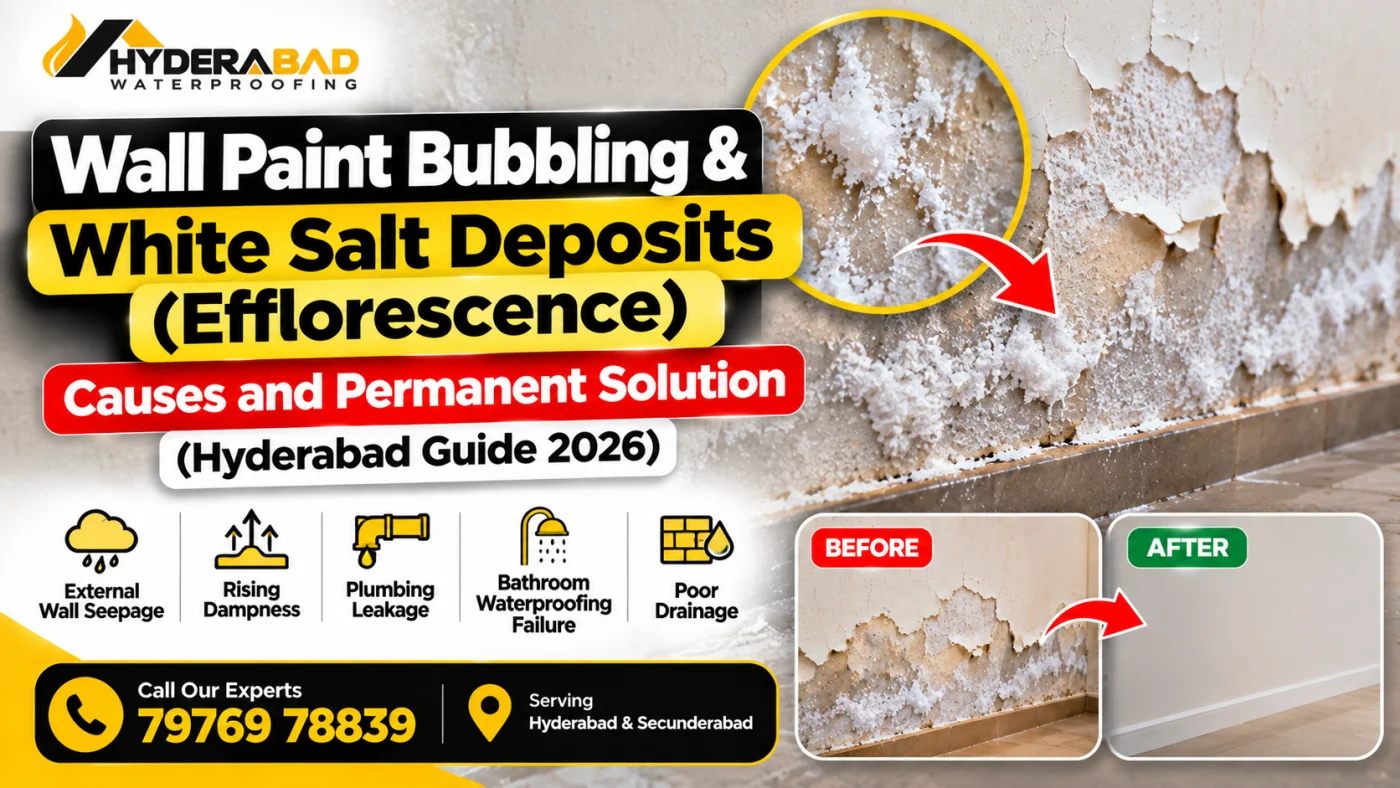
Have you noticed white powder, crystal-like deposits, or salt marks appearing on your interior or exterior walls? Is your wall paint bubbling, peeling, or developing patches even after repainting?
These problems may indicate a condition called efflorescence.
Efflorescence occurs when water moves through porous building materials and carries dissolved salts towards the surface. As the moisture evaporates, the salts remain behind, creating visible white deposits on the wall.
In Hyderabad, wall dampness and efflorescence can occur in apartments, independent houses, commercial buildings, basements, and older properties. Common contributing factors include external wall seepage, plumbing leakage, moisture rising from the ground, and inadequate waterproofing.
Simply scraping off the white powder or applying another coat of paint does not address the underlying moisture source. If water continues entering the wall, the deposits and paint damage may return.
In this guide, Hyderabad Waterproofing Services explains why white salt deposits appear, how to identify the source of dampness, and which treatments can help provide a long-term solution.
What Is Efflorescence on Walls?
Efflorescence is the formation of white, powdery or crystalline salt deposits on the surface of concrete, brickwork, plaster, or masonry.
It usually develops through the following process:
Water enters porous concrete, brickwork, mortar, or plaster.
The moisture dissolves naturally occurring soluble salts within the building material or surrounding environment.
Water travels towards the wall surface through pores and capillaries.
Moisture evaporates when it reaches the surface.
Dissolved salts remain behind as white powder or crystal-like deposits.
Efflorescence is often a sign of moisture movement, but it does not automatically indicate structural damage. However, recurring deposits accompanied by dampness, peeling paint, or deteriorating plaster should be investigated.
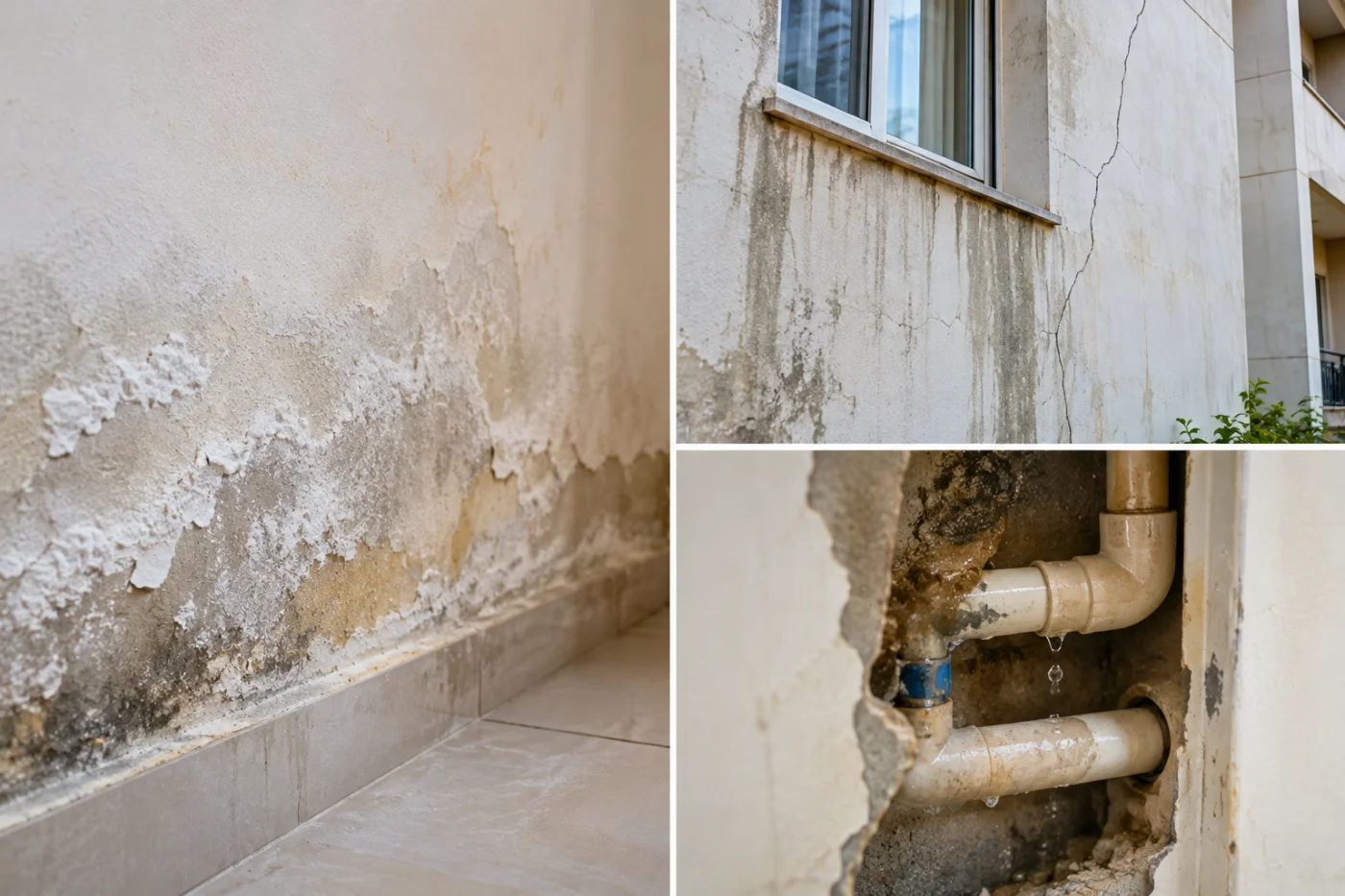
What Causes White Salt Deposits on Walls in Hyderabad?
Several moisture-related problems can contribute to efflorescence. Identifying the actual source is essential before selecting a treatment.
1. External Wall Seepage
Rainwater can penetrate exterior walls through cracks, porous plaster, damaged coatings, window joints, and gaps around service penetrations.
When moisture travels through the wall, it can carry dissolved salts towards the interior surface.
Common signs:
White powder appearing on internal walls after rainfall.
Paint bubbling near external-facing walls.
Damp patches around windows.
Repeated peeling of interior paint.
White deposits returning after cleaning.
Recommended solution:
Inspect the exterior wall for cracks, damaged plaster, defective joints, and failed waterproof coatings. Depending on the condition, treatment may include crack repair, joint sealing, plaster restoration, and a compatible exterior waterproofing system.
2. Rising Dampness From the Ground
Rising dampness occurs when moisture moves upwards through porous masonry from the ground or persistently wet building materials.
It can affect ground-floor walls, older buildings, boundary walls, and properties with inadequate or damaged damp-proofing arrangements.
Common signs:
White salt deposits near skirting level.
Peeling paint along the bottom of walls.
Damp plaster close to the floor.
Repeated damage to lower wall sections.
Deteriorating plaster and salt accumulation.
Recommended solution:
The wall base, surrounding ground conditions, drainage, and existing damp-proofing details should be assessed. Depending on the diagnosis, treatment may involve drainage correction, a suitable damp-proofing intervention, removal of salt-contaminated plaster, and compatible replastering.
3. Concealed Plumbing Leakage
Leaking water supply pipes, drainage connections, and concealed bathroom plumbing can introduce moisture into walls.
This moisture may carry salts through plaster and masonry, creating white deposits and paint damage.
Common signs:
Damp patches near bathrooms or kitchens.
White deposits appearing in one particular area.
Moisture that persists even during dry weather.
Paint bubbling around concealed pipe routes.
Recurring dampness after repainting.
Recommended solution:
Inspect the suspected plumbing lines and connections. Appropriate testing may be required to identify the leakage location. Repair the defective pipe or fitting before restoring the affected plaster and paint.
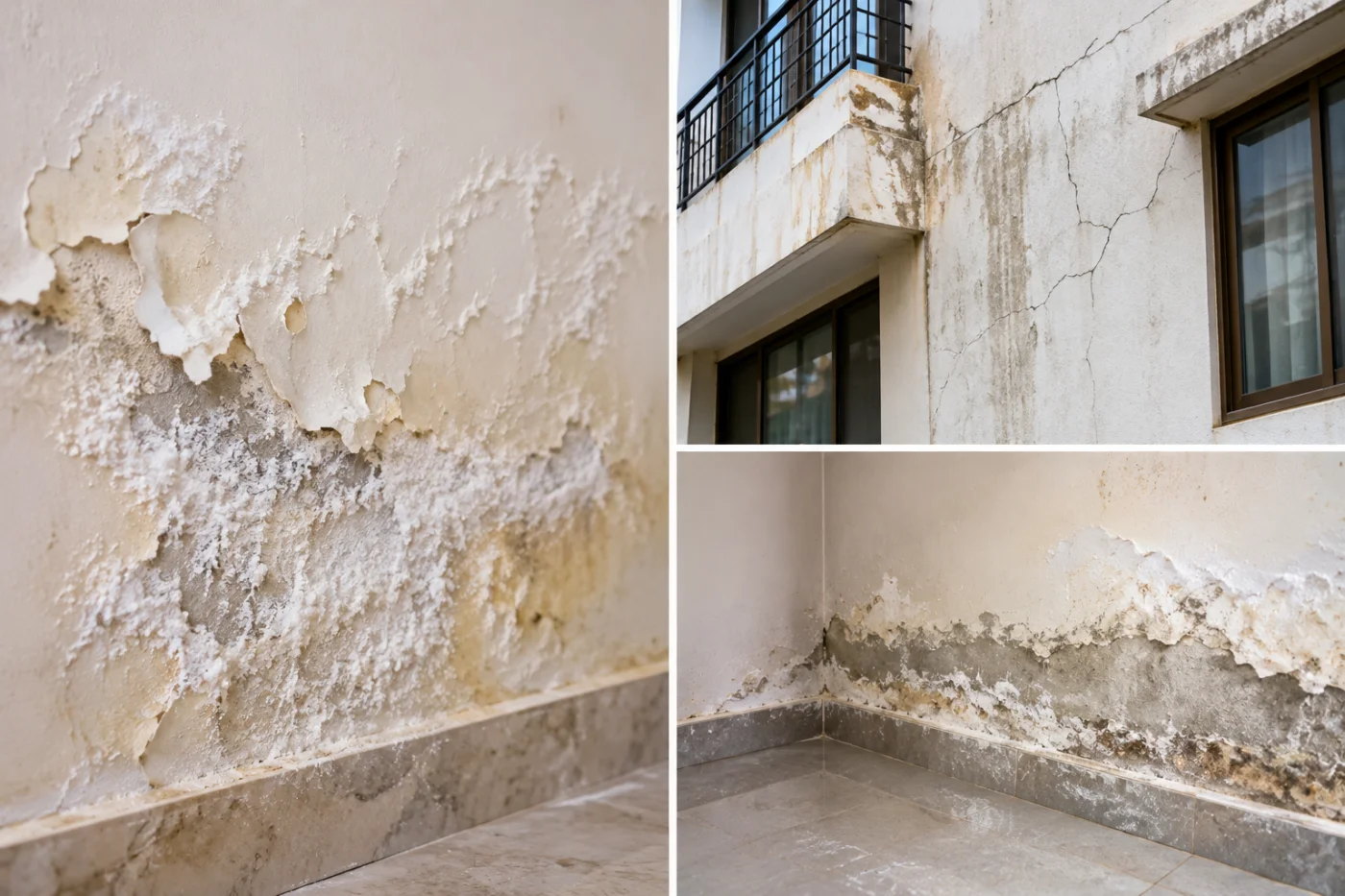
4. Bathroom and Balcony Waterproofing Failure
Bathrooms, balconies, utility areas, and wet zones can expose adjoining walls to moisture when waterproofing layers, floor joints, or plumbing connections fail.
Water may travel through masonry and appear on the other side of a wall.
Common signs:
White deposits on walls adjoining bathrooms.
Dampness below balcony floor levels.
Peeling paint near wet areas.
Leakage that becomes noticeable after bathroom use.
Repeated moisture near floor-wall junctions.
Recommended solution:
Inspect the bathroom or balcony waterproofing system, floor traps, pipe connections, and wall-floor joints. Repair the source using an appropriate waterproofing or plumbing treatment.
5. Poor Drainage and Water Accumulation
Water collecting around building foundations, basement walls, or external surfaces can increase moisture exposure.
Blocked drains, incorrect surface slopes, and poor rainwater management may contribute to dampness and salt deposits.
Common signs:
Dampness near the base of external walls.
White deposits on basement walls.
Moisture appearing after heavy rainfall.
Repeated damp patches around foundation-level surfaces.
Recommended solution:
Check drainage outlets, surface slopes, water collection points, and foundation exposure. Correcting water accumulation may be an important part of the overall dampness treatment.
How to Identify Efflorescence vs Other Wall Problems
Not every white mark on a wall is efflorescence. It is important to distinguish salt deposits from mould, paint damage, and other surface defects.
| Wall Condition | Typical Appearance | Possible Cause |
|---|---|---|
| Efflorescence | White powder or crystalline deposits | Moisture carrying dissolved salts |
| Paint bubbling | Raised or blistered paint | Moisture trapped beneath paint |
| Paint peeling | Flaking or detached paint | Moisture, poor adhesion, or surface deterioration |
| Mould growth | Dark green, black, or grey patches | Persistent moisture and suitable growth conditions |
| Damp plaster | Darkened, soft, or deteriorating surface | Water penetration or moisture accumulation |
| White paint residue | Thin white surface marks | Paint deterioration or salt deposits |
A visual inspection can provide clues, but identifying the actual moisture source may require additional investigation.
Permanent Solutions for White Salt Deposits and Wall Dampness
A long-term repair should address both the visible wall damage and the source of moisture.
1. Remove Existing Salt Deposits
Loose white deposits should be removed using suitable dry brushing and controlled surface cleaning methods.
Important precautions:
Avoid spreading salt residue to unaffected areas.
Do not simply paint over visible deposits.
Avoid excessive water during cleaning.
Use appropriate protective equipment.
Check whether the deposits return after cleaning.
Removing the salt improves the surface condition, but it does not stop the moisture source.
2. Identify and Repair the Moisture Source
This is the most important step.
The contractor should investigate whether moisture is entering through an external wall, plumbing line, bathroom, balcony, foundation, or another source.
Applying an internal coating without resolving the source may lead to recurring dampness.
3. Remove Damaged Plaster Where Necessary
If plaster has become loose, hollow, salt-contaminated, or significantly deteriorated, affected sections may need removal.
The repair may involve:
Removing loose plaster.
Cleaning the exposed substrate.
Assessing the underlying masonry.
Applying a suitable repair or damp-resistant plaster system.
Allowing the repaired area to dry adequately.
The extent of plaster removal should be determined according to the actual condition of the wall.
4. Apply Suitable Waterproofing Treatment
The waterproofing method depends on the identified source.
Possible systems include:
External wall waterproof coatings.
Flexible crack and joint sealing systems.
Cementitious waterproofing for compatible substrates.
Suitable damp-proofing treatments.
Injection grouting for selected leakage paths.
Bathroom or balcony waterproofing restoration.
The selected product must be appropriate for the substrate, moisture condition, and exposure.
5. Restore Paint and Wall Finishing
Repainting should be completed only after the moisture source has been addressed and the wall has reached a suitable condition for finishing.
The restoration process may include:
Surface preparation.
Compatible primer application.
Suitable putty or plaster finishing.
Interior paint application.
Using decorative paint before the wall is adequately dry can result in bubbling and peeling again.
Which Wall Dampness Treatment Is Suitable for Your Property?
| Problem | Recommended Treatment Approach |
|---|---|
| White salt deposits on external-facing walls | Inspect and repair exterior water-entry points |
| Dampness near floor level | Assess rising dampness and drainage |
| Damp wall adjoining a bathroom | Inspect plumbing and bathroom waterproofing |
| Efflorescence on basement walls | Assess groundwater exposure and drainage |
| Cracks with active water leakage | Consider suitable crack repair or injection grouting |
| Repeated paint bubbling | Identify moisture source before repainting |
There is no single waterproofing material that permanently solves every efflorescence problem. Treatment should be selected after assessing the wall and its moisture source.
Wall Dampness Treatment Cost in Hyderabad
The cost of wall dampness and efflorescence treatment depends on the affected area, moisture source, plaster condition, access requirements, and materials selected.
The following figures are indicative budgeting estimates, not fixed quotations.
| Treatment Type | Indicative Cost |
|---|---|
| Basic internal damp-resistant coating | ₹25–₹60 per sq ft |
| Internal wall dampness treatment | ₹40–₹100 per sq ft |
| External wall waterproof coating | ₹30–₹100 per sq ft |
| Localised crack and joint sealing | Depends on crack length and repair material |
| Damaged plaster removal and restoration | Depends on area and plaster thickness |
| Rising damp treatment | Requires site assessment; may be priced by running foot or affected area |
The final quotation should specify whether it includes salt removal, plaster removal, surface preparation, waterproofing materials, primer, putty, painting, access arrangements, and taxes.
For larger apartment projects, the cost may also depend on the number of affected flats and whether the source is located in a common external wall or shared service area.
Why Does White Salt Return After Repainting?
This is one of the most common problems faced by homeowners.
Repainting may temporarily improve the appearance of a wall, but it does not necessarily address the underlying moisture movement.
White salt deposits may return because:
External water penetration has not been repaired.
Concealed plumbing leakage continues.
Rising dampness remains untreated.
Salt-contaminated plaster has not been adequately removed.
The wall was painted before sufficient drying.
The selected coating was unsuitable for the moisture conditions.
The correct sequence is to identify the source, control moisture entry, repair damaged materials, allow appropriate drying, and then restore the wall finish.
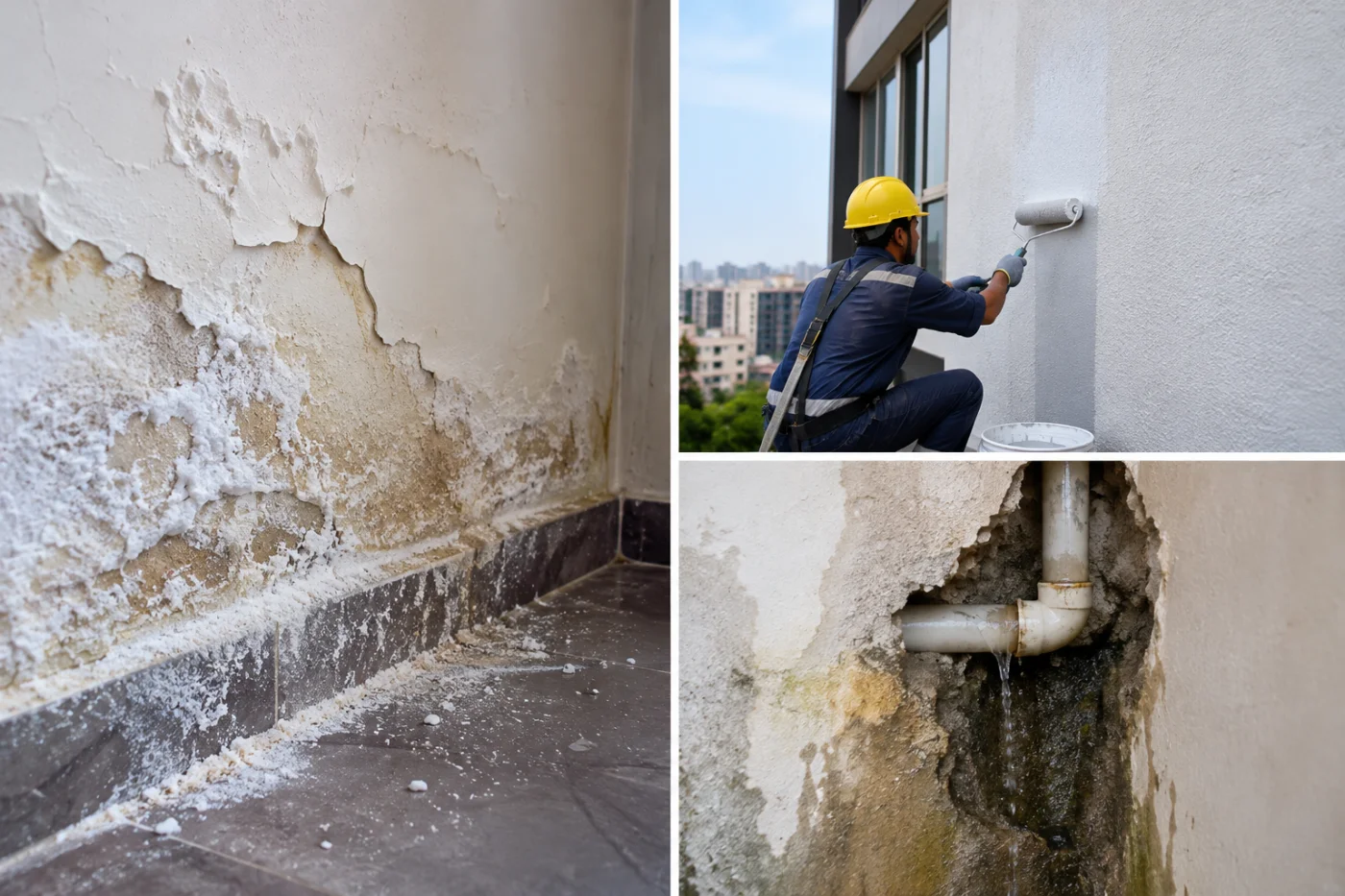
How to Prevent Efflorescence and Wall Dampness
Homeowners and apartment associations can reduce moisture-related problems through regular building maintenance.
Inspect external walls before the monsoon.
Repair cracks and defective window joints.
Keep terrace and balcony drainage outlets clear.
Check bathroom plumbing and floor traps periodically.
Prevent water from collecting near foundation walls.
Repair damaged exterior waterproofing systems.
Investigate recurring damp patches instead of repeatedly repainting them.
Allow repaired walls to dry adequately before applying decorative finishes.
Early attention to moisture problems can help prevent extensive plaster deterioration and repeated painting expenses.
Wall Dampness and Efflorescence Treatment for Hyderabad Apartments
In apartment buildings, the source of wall dampness may be located outside the affected flat.
For example, an internal bedroom wall may develop white salt deposits because of external wall seepage. Similarly, a damp patch adjoining a bathroom may be caused by plumbing or waterproofing failure in another apartment.
Apartment associations and property managers should consider the following steps:
Record the location of every affected wall.
Check whether dampness appears in multiple flats.
Identify whether affected walls share an external surface or plumbing shaft.
Inspect common terraces, balconies, and drainage areas.
Determine whether the repair belongs to a common area or an individual flat.
Obtain a written treatment scope before approving restoration work.
Hyderabad Waterproofing Services assists homeowners, apartment associations, and commercial property managers with wall seepage assessment, dampness treatment, crack repair, and waterproofing solutions across Hyderabad and Secunderabad.
Our Wall Dampness and Efflorescence Treatment Process
Step 1: Site Inspection
The affected walls are examined for white salt deposits, damp patches, paint bubbling, cracks, and plaster deterioration.
Step 2: Moisture Source Assessment
The team investigates possible external seepage, plumbing leakage, rising dampness, bathroom leakage, and drainage-related problems.
Step 3: Treatment Recommendation
A suitable repair approach is recommended according to the moisture source, wall condition, and accessibility.
Step 4: Surface Preparation
Loose paint, damaged plaster, and salt-contaminated material are addressed according to the approved scope.
Step 5: Waterproofing and Repair
The selected waterproofing, crack repair, damp-proofing, or plaster restoration system is applied according to its technical requirements.
Step 6: Quality Checks
The completed work is inspected against the agreed scope. Appropriate drying and finishing requirements are explained before repainting.
Step 7: Handover
The property owner receives details of the work completed, maintenance recommendations, and applicable written warranty terms.
Frequently Asked Questions
1. What causes white salt deposits on walls?
White salt deposits, known as efflorescence, develop when moisture carries dissolved salts through porous masonry, concrete, or plaster. When the moisture evaporates, the salts remain on the wall surface.
2. How can I permanently remove white salt from my walls?
First identify and repair the source of moisture. Then remove loose salt deposits, address damaged plaster where necessary, allow the wall to dry adequately, and apply a suitable repair and finishing system.
3. Does white salt on walls mean water leakage?
Not always, but it indicates that moisture and soluble salts have reached the surface. The moisture may come from external seepage, plumbing leakage, rising dampness, or other sources.
4. Why does my wall paint bubble after repainting?
Paint may bubble because moisture remains inside the wall, the original leakage source has not been repaired, or the surface was not sufficiently dry before repainting.
5. Can waterproof paint stop efflorescence permanently?
A suitable coating may help under certain conditions, but it cannot reliably resolve every source of moisture. The underlying water-entry path must be identified and addressed.
6. What is the cost of wall dampness treatment in Hyderabad?
Selected wall dampness treatments may cost approximately ₹25–₹100 per sq ft, depending on preparation, coating system, and wall condition. Extensive plaster restoration, plumbing repairs, or exterior access may increase the total cost.
7. Is efflorescence harmful to the building?
Efflorescence itself is generally a visible indicator of salt movement rather than proof of structural failure. However, persistent moisture can contribute to plaster deterioration, paint damage, corrosion-related problems, and concrete deterioration under certain conditions.
8. Can efflorescence appear on new buildings?
Yes. New concrete, brickwork, and plaster may contain soluble salts, and moisture movement can bring them to the surface. Repeated deposits or associated dampness should be investigated to rule out ongoing water entry.
9. Which areas of Hyderabad do you serve?
Hyderabad Waterproofing Services serves Hyderabad and Secunderabad, including Gachibowli, Madhapur, Kondapur, Kukatpally, Miyapur, Manikonda, Banjara Hills, Jubilee Hills, Hitec City, Begumpet, and nearby areas, subject to project requirements.
Conclusion
White salt deposits, bubbling paint, and recurring damp patches are signs that moisture may be moving through your walls. Simply cleaning the white powder or repainting the affected area will not provide a reliable long-term solution if the underlying moisture source remains untreated.
For effective white salt on walls repair in Hyderabad, the first step is identifying whether the problem comes from external wall seepage, rising dampness, plumbing leakage, bathroom waterproofing failure, or poor drainage.
Once the source is controlled, damaged plaster can be restored and a suitable waterproofing and finishing system can be applied.
If your apartment or property has recurring efflorescence, wall dampness, or paint peeling, arrange a professional site assessment before investing in another repainting job.
Contact Hyderabad Waterproofing Services
Wall Dampness Treatment | Efflorescence Repair | External Wall Waterproofing | Crack Repair | Seepage Treatment
Phone: +91 79769 78839
Website: https://hyderabadwaterproofing.in
Service Areas: Hyderabad and Nearby Areas
Schedule a site visit with our engineering team to assess the moisture source and determine a suitable wall dampness treatment.